




Ramadan Mubarak 2026 marks the beginning of the holy month of Ramadan-ul-Mubarak 1447 AH, a period of fasting, reflection, and spiritual devotion for Muslims worldwide.
This year, the sacred month is expected to begin on Thursday, February 19, 2026, following the sighting of the crescent moon by the Central Ruet-e-Hilal Committee.
Muslims will observe fasting every day from suhoor (pre-dawn meal) to iftar (sunset meal) for approximately 29–30 days, culminating in the celebration of Eid ul-Fitr in March 2026.
When Does Ramadan 2026 Start and End?
Because the Islamic calendar is lunar-based, the start of Ramadan shifts about 10–11 days earlier each year compared with the Gregorian calendar.
In 2026, crescent sightings in Pakistan and South Asia on the evening of February 17 confirmed that Ramadan began on February 19 for most Muslim communities.
The month will last until the sighting of the Shawwal crescent, expected around March 18 or 19, 2026, when Eid ul-Fitr celebrations will begin.
This month is deeply significant for Muslims, as it involves acts of prayer, charity, Quran recitation, and self-discipline through fasting.

What Ramadan Means for Muslims
During Ramadan, Muslims fast daily between dawn (Fajr) and sunset (Maghrib).
Fasting involves abstaining from food, drink, and smoking, as well as other physical needs, during daylight hours.
The fast is broken at sunset with iftar, often starting with dates and water, followed by a full evening meal.
Suhoor, the pre-dawn meal, is eaten before the Fajr prayer. The duration of fasting varies by location, but in Pakistan and South Asia in February, fasts are generally about 12–13 hours long, depending on sunrise and sunset times.
School Timings During Ramadan Mubarak 2026 (Pakistan)
In Pakistan, education authorities and provincial governments have issued official revised school timings for the holy month, recognising the need to ease schedules for fasting students and staff.
Punjab and Sindh School Timings
- Single-Shift Schools: Classes start at 8:00 am and finish by 12:30 pm Monday–Thursday.
- Double-Shift Schools: The first shift runs from 7:30 am to 11:30 am, and the second shift from 11:45 am to 2:45 pm.
- Friday Hours: Single-shift schools operate from 8:00 am to 11:30 am; for double-shift schools, the first shift is from 7:30 am to 10:30 am, and the second shift is from 11:45 am to 1:15 pm.
Government notifications state that these revised school hours are in effect throughout Ramadan to accommodate students (especially those fasting) while ensuring educational continuity.
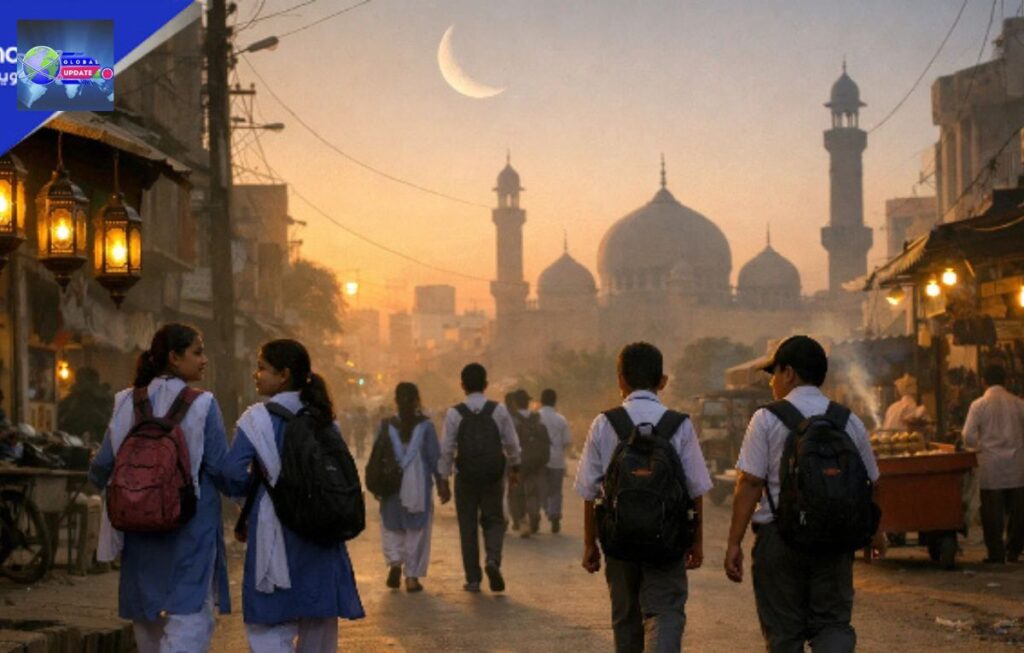
Karachi School Timing Update
Karachi also announced local adjustments:
- Single-shift schools from 8:00 am to 12:30 pm.
- Double-shift schools with sessions from 8:00 am to 11:00 am and 11:45 am to 2:45 pm.
These timings help students complete classes before the peak fasting hours.
University Adjustments
Institutions like Quaid-i-Azam University also revised office and class timings for Ramadan:
- Monday–Thursday: 8:00 am to 2:00 pm
- Friday: 8:00 am to 12:00 pm
This reflects a broader trend among university administrations to support faculty, staff, and students during Ramadan.
Office Timings During Ramadan 2026 (Pakistan)
Adjustments to work schedules are common in Pakistan to help employees balance religious practice and professional responsibilities during Ramadan.
The federal government issued official guidelines for office hours for federal offices and departments.

🕒 Revised Office Schedule
- Monday to Thursday: 9:00 am to 3:00 pm
- Friday: 9:00 am to 12:30 pm
- Government offices operating six days a week may follow a slightly modified schedule, such as 9:00 am to 2:00 pm on Saturdays.
These changes aim to ensure staff ease their workloads while observing fasting and participating in Tarawih prayers in the evenings.
They are also in line with broader public sector schedules during Ramadan.
Bank Timings During Ramadan 2026 (Pakistan)
The State Bank of Pakistan (SBP)—the central bank—also announced revised office and business hours for banks nationwide during Ramadan to balance operational needs and staff wellbeing.
Bank Office Hours (Internal)
- Monday–Thursday: 9:00 am to 3:00 pm (no break)
- Friday: 9:00 am to 12:30 pm (no break)
These hours apply to all commercial banks, development finance institutions (DFIs), and microfinance banks (MFBs), ensuring banking operations continue smoothly during the holy month.

Banking Hours for Public Dealing
For customer services such as cash deposits, withdrawals, and other transactions:
- Monday–Thursday: 9:00 am to 2:00 pm (no break)
- Friday: 9:00 am to 12:30 pm (no break)
The SBP emphasised that after Ramadan, banks will automatically revert to their regular pre-Ramadan timings.
First Day “Bank Holiday”
Many branches will be closed to the public on the first day of Ramadan (Ramadan-ul-Mubarak), as banks focus on internal processes and the annual deduction of Zakat. However, internal operations may continue as usual.
Ramadan Schedule Adjustments Across the Muslim World
While this article focuses primarily on Pakistan, it’s worth noting that countries across the Muslim world also adjust their routine schedules during Ramadan. For example:
- In Qatar, government schools and kindergartens set shortened hours for students and administrative staff during Ramadan.
- In the Middle East (UAE, Saudi Arabia) and South Asia, major institutions release revised timings that balance fasting hours with daily responsibilities, reflecting priorities similar to those in Pakistan. (The National)
These adjustments help communities maintain productivity while respecting the spiritual and physical demands of fasting.
Fasting Hours and Moon Sightings
The exact start of Ramadan depends on the sighting of the crescent moon, a practice rooted in Islamic tradition.
In 2026, sightings across Pakistan and neighbouring regions confirmed that Ramadan began on February 19. Muslims track suhoor (pre-dawn meal) and iftar (sunset breaking of fast) times daily, which vary slightly from city to city.
Fasting duration in Pakistan typically ranges from about 12 to 13 hours at this time of year, shorter than the summer months but still significant.
Spiritual and Cultural Importance of Ramadan Mubarak 2026
Ramadan is not just about fasting; it emphasises prayer, charity, self-restraint, and community unity.
Muslims strive to increase good deeds, recite more of the Quran, and engage in acts of generosity.
Many families and communities also gather each evening for iftar, strengthening social bonds.
The month culminates in Eid ul-Fitr, a festive day that celebrates the completion of the fast with special prayers, charity (Zakat al-Fitr), feasting, and family gatherings.
Key Takeaways for Ramadan Mubarak 2026
- 🌙 Ramadan began on February 19, 2026, in Pakistan after the moon sighting.
- 🕌 Fasts will continue daily until mid-March, ending with Eid ul-Fitr.
- 🏫 School timings are shortened to ease fasting students’ schedules.
- 💼 Office timings for government and federal offices have been officially revised.
- The SBP adjusts bank hours for public dealings and internal operations.
- 🕌 Ramadan is a spiritually significant period observed by millions worldwide, emphasising empathy, patience, and devotion.